'I feel like my prayers are just bouncing off the ceiling.'
I've heard this one. Most of us have. We may have even uttered it from time to time. While I understand the sentiment, and that it is genuine at times, it reflects a horrible failure to grasp some basic theology.
First, God is not (solely) 'out there.' God is with us. A few verses state this point clearly.
"The Lord is near to the brokenhearted and saves the crushed in spirit." (Psalm 34:18)
"The Lord is near to all who call on him, to all who call on him in truth." (Psalm 145:18
"Draw near to God, and he will draw near to you." (James 4:8a)
We miss a crucial point when we posit our heavenly Father "somewhere out there." "Our father who is in heaven" could be rendered, "Our father who is as close as my next breath, and as all around me as the stars up above." We are so afraid of being pantheist (God in everything) that we try to drive him totally out of our surroundings for his own safety.
Secondly, we, as believers, we have God within us. Let us not forget the Trinity--Father, Son and Holy Spirit. The third person of the triune godhead lives within each believer. We are in-dwelt by the Holy Spirit. I'm not sure what that typically means to you, but if we take the doctrine of the trinity seriously, it means that God is within us.
The logical deduction from this is that our prayers don't even have to pass our lips, let alone make it to the ceiling to come before the throne of grace.
"Likewise the Spirit helps us in our weakness. For we do not know what to pray for as we ought, but the Spirit himself intercedes for us with groanings too deep for words. And he who searches hearts knows what is the mind of the Spirit, because the Spirit intercedes for the saints according to the will of God." (Romans 8:26-27)
The Spirit can do this because the Spirit is within us, cohabiting with our own spirits. (Which makes you wonder how on earth we could ever think we could hide anything from God.)
All of this, of course, is why we can pray "in our heads" and still be heard. So, if you're praying silently anyway, how could your prayer "get past the ceiling?" Because it does not need to. God is with you.
Immanuel--God with us. The gift of the Nativity. We would do well to remember it. He hears our prayers. The Holy Spirit is living in and with our spirit, and praying for us--keeping us in constant communication with God, even when we aren't consciously praying.
So, the only way your prayers can 'bounce off the ceiling' is if your theology is off the wall....I pray that is not the case.
27 October 2011


16 October 2011
God is God
"In the beginning God…" Genesis 1:1
Theology, rightly understood, is learning about God, it is not creating or defining God. When we look at Scripture, the first thing we are told is, "In the beginning, God." This is where all understanding, knowledge, wisdom, experience and existence has its genesis. God is the source, the author, the creator of all. Nothing pre-exists Him. He is the irreducible source of all things.
One often hears talk about, "this or that kind of god," or, "A god that would do or allow such and such." In reality, such talk is ludicrous and nonsensical. If God is god, then there is only one God and what we think of Him is of no consequence to his identity and being whatsoever. We can either seek to believe and know the truth, or we can choose to believe fantasies of our own making.
You may believe me to be the Easter Bunny. Your mistaken belief does nothing to change my identity. It will impact the way you relate to me. Ultimately, such a mistaken belief will cause you to relate to me in ways that are inappropriate and lead to disappointment and misunderstanding.
We only have 2 choices in relating to God, to accept him or to reject him. To obey or disobey, to believe or disbelieve. We do not have the option to change him.
When we discuss a "type" of God, what we generally mean is the interpretation or understanding that a particular person or group has of God. Phrases such as, "The God of the Catholics," or "The Muslim God" would be more accurately rendered as, "the Catholic conception of God," or, "The Muslim understanding of God." These may be studied, and analyzed, but they are of little value if they are not the truth. It is akin to someone who studies the "Star Wars universe." They may have much knowledge of Ewoks and Jawas and the Empire. Ultimately, however, it is of little value because it has nothing to do with reality.
One must take into account deception from the supernatural. Satan desires to lead us astray, and if he can do that through giving us a false god to worship, he is perfectly content to do so. It is important to acknowledge that this is not just a passive pursuit, but a battle that is being waged all around us for our souls through the revealing and distorting of truth.
Our goal, as Christians, is to understand God as he really is. This is important, because it is the God who really is who we will have to answer to. It is the God who really is who holds our destiny and existence in his power. Understanding the "God who is" is of prime importance for all knowledge and survival.
Theology is not just a discipline, it is the primary and foundational science for humanity. To leave theology entirely to ivory tower academics is not only lazy, it is irresponsible. Assuming that God interacts with and has concern for individuals, then we, as individuals, should reciprocate the same interest toward God. Since understanding God is foundational to all knowledge, whatever our vocation or interest, understanding God is a prerequisite to right understanding and living.
We must understand God if we are to understand anything in our world or in our lives as it truly is. We are citizens of the Kingdom of Heaven. It is not a democracy. We serve a king, we need to understand his will, his desires and his rules. We are created in his image, he does not need us to return the favor and try to create him in our image. To do so is idolatry.
Theology, rightly understood, is learning about God, it is not creating or defining God. When we look at Scripture, the first thing we are told is, "In the beginning, God." This is where all understanding, knowledge, wisdom, experience and existence has its genesis. God is the source, the author, the creator of all. Nothing pre-exists Him. He is the irreducible source of all things.
One often hears talk about, "this or that kind of god," or, "A god that would do or allow such and such." In reality, such talk is ludicrous and nonsensical. If God is god, then there is only one God and what we think of Him is of no consequence to his identity and being whatsoever. We can either seek to believe and know the truth, or we can choose to believe fantasies of our own making.
You may believe me to be the Easter Bunny. Your mistaken belief does nothing to change my identity. It will impact the way you relate to me. Ultimately, such a mistaken belief will cause you to relate to me in ways that are inappropriate and lead to disappointment and misunderstanding.
We only have 2 choices in relating to God, to accept him or to reject him. To obey or disobey, to believe or disbelieve. We do not have the option to change him.
When we discuss a "type" of God, what we generally mean is the interpretation or understanding that a particular person or group has of God. Phrases such as, "The God of the Catholics," or "The Muslim God" would be more accurately rendered as, "the Catholic conception of God," or, "The Muslim understanding of God." These may be studied, and analyzed, but they are of little value if they are not the truth. It is akin to someone who studies the "Star Wars universe." They may have much knowledge of Ewoks and Jawas and the Empire. Ultimately, however, it is of little value because it has nothing to do with reality.
One must take into account deception from the supernatural. Satan desires to lead us astray, and if he can do that through giving us a false god to worship, he is perfectly content to do so. It is important to acknowledge that this is not just a passive pursuit, but a battle that is being waged all around us for our souls through the revealing and distorting of truth.
Our goal, as Christians, is to understand God as he really is. This is important, because it is the God who really is who we will have to answer to. It is the God who really is who holds our destiny and existence in his power. Understanding the "God who is" is of prime importance for all knowledge and survival.
Theology is not just a discipline, it is the primary and foundational science for humanity. To leave theology entirely to ivory tower academics is not only lazy, it is irresponsible. Assuming that God interacts with and has concern for individuals, then we, as individuals, should reciprocate the same interest toward God. Since understanding God is foundational to all knowledge, whatever our vocation or interest, understanding God is a prerequisite to right understanding and living.
We must understand God if we are to understand anything in our world or in our lives as it truly is. We are citizens of the Kingdom of Heaven. It is not a democracy. We serve a king, we need to understand his will, his desires and his rules. We are created in his image, he does not need us to return the favor and try to create him in our image. To do so is idolatry.
29 September 2011
Guest Writer: Dietrich Bonhoeffer
From Life Together
Thankfulness works in the Christian community as it usually does in the Christian life. Only those who give thanks for the little things receive the great things as well. We prevent God from giving us the great spiritual gifts prepared for us because we do not give thanks for the daily gifts. We think that we should not be satisfied with the small measure of spiritual knowledge, experience, and love that has been given to us, and that we must be constantly seeking the great gifts. Then we complain that we lack the deep certainty, the strong faith, and the rich experiences that God has given to other Christians, and we consider these complaints to be pious. We pray for the big things and forget to give thanks for the small (and yet really not so small!) gifts we receive daily. How can God entrust great things to those who will not gratefully receive the little things from God's hand? If we do not give thanks daily for the Christian community in which we have been placed, even when there are no great experiences, no noticeable riches, but much weakness, difficulty, and little faith--and if, on the contrary, we only keep complaining to God that everything is so miserable and so insignificant and does not at all live up to our expectations--then we hinder God from letting our community grow according to the measure and riches that are there for us all in Jesus Christ. That also applies in a special way to the complaints often heard from pastors and zealous parishioners about their congregations. Pastors should not complain about their congregation, certainly never to other people, but also not to God. Congregations have not been entrusted to them in order that they should become accusers of their congregations before God and their fellow human beings. When pastors lose faith in a Christian community in which they have been placed and begin to make accusations against it, they had better examine themselves first to see whether the underlying problem is not their own idealized image, which should be shattered by God. And if they find that to be true, let them thank God for leading them into this predicament. But if they find it is not true, let them nevertheless guard against ever becoming an accuser of those whom God has gathered together. Instead, let them accuse themselves of their unbelief, let them ask for an understanding of their own failure and their particular sin, and pray that they may not wrong other Christians. Let such pastors, recognizing their own guilt, make intercession for those charged to their care. Let them do what they have been instructed to do and thank God.
p. 37-38, Fortress Press, Minneapolis, 1996
Thankfulness works in the Christian community as it usually does in the Christian life. Only those who give thanks for the little things receive the great things as well. We prevent God from giving us the great spiritual gifts prepared for us because we do not give thanks for the daily gifts. We think that we should not be satisfied with the small measure of spiritual knowledge, experience, and love that has been given to us, and that we must be constantly seeking the great gifts. Then we complain that we lack the deep certainty, the strong faith, and the rich experiences that God has given to other Christians, and we consider these complaints to be pious. We pray for the big things and forget to give thanks for the small (and yet really not so small!) gifts we receive daily. How can God entrust great things to those who will not gratefully receive the little things from God's hand? If we do not give thanks daily for the Christian community in which we have been placed, even when there are no great experiences, no noticeable riches, but much weakness, difficulty, and little faith--and if, on the contrary, we only keep complaining to God that everything is so miserable and so insignificant and does not at all live up to our expectations--then we hinder God from letting our community grow according to the measure and riches that are there for us all in Jesus Christ. That also applies in a special way to the complaints often heard from pastors and zealous parishioners about their congregations. Pastors should not complain about their congregation, certainly never to other people, but also not to God. Congregations have not been entrusted to them in order that they should become accusers of their congregations before God and their fellow human beings. When pastors lose faith in a Christian community in which they have been placed and begin to make accusations against it, they had better examine themselves first to see whether the underlying problem is not their own idealized image, which should be shattered by God. And if they find that to be true, let them thank God for leading them into this predicament. But if they find it is not true, let them nevertheless guard against ever becoming an accuser of those whom God has gathered together. Instead, let them accuse themselves of their unbelief, let them ask for an understanding of their own failure and their particular sin, and pray that they may not wrong other Christians. Let such pastors, recognizing their own guilt, make intercession for those charged to their care. Let them do what they have been instructed to do and thank God.
p. 37-38, Fortress Press, Minneapolis, 1996
13 September 2011
Prayer Is Preparation
From today's entry for Experiencing God Day By Day. Too good not to share--
When the Day of Pentecost had fully come, they were all with one accord in one place. (Acts 2:1)
Prayer does not give you spiritual power. Prayer aligns your life with God so that He chooses to demonstrate His power through you. The purpose of prayer is not to convince God to change your circumstances but to prepare you to be involved in God’s activity.
The fervent prayer of the people at Pentecost did not induce the Holy Spirit to come upon them. Prayer brought them to a place where they were ready to participate in the mighty work God had already planned.
Jesus told His followers to remain in Jerusalem until the Spirit came upon them (Acts 1:4–5). The disciples obeyed His command, waiting for God’s next directive. As they prayed, God adjusted their lives to what He intended to do next. As they prayed, a unity developed among them. For the first time the disciples used Scripture as their guide in decision making (Acts 1:15–26). The day of Pentecost arrived, and the city of Jerusalem filled with pilgrims from around the world. When God released His Holy Spirit upon the disciples, He had already filled the city with messengers who would carry the Gospel to every nation. Prayer had prepared the disciples for their obedient response.
Prayer is designed to adjust you to God’s will, not to adjust God to your will. If God has not responded to what you are praying, you may need to adjust your praying to align with God’s agenda. Rather than focusing on what you would like to see happen, realize that God may be more concerned with what He wants to see happen in you.
When the Day of Pentecost had fully come, they were all with one accord in one place. (Acts 2:1)
Prayer does not give you spiritual power. Prayer aligns your life with God so that He chooses to demonstrate His power through you. The purpose of prayer is not to convince God to change your circumstances but to prepare you to be involved in God’s activity.
The fervent prayer of the people at Pentecost did not induce the Holy Spirit to come upon them. Prayer brought them to a place where they were ready to participate in the mighty work God had already planned.
Jesus told His followers to remain in Jerusalem until the Spirit came upon them (Acts 1:4–5). The disciples obeyed His command, waiting for God’s next directive. As they prayed, God adjusted their lives to what He intended to do next. As they prayed, a unity developed among them. For the first time the disciples used Scripture as their guide in decision making (Acts 1:15–26). The day of Pentecost arrived, and the city of Jerusalem filled with pilgrims from around the world. When God released His Holy Spirit upon the disciples, He had already filled the city with messengers who would carry the Gospel to every nation. Prayer had prepared the disciples for their obedient response.
Prayer is designed to adjust you to God’s will, not to adjust God to your will. If God has not responded to what you are praying, you may need to adjust your praying to align with God’s agenda. Rather than focusing on what you would like to see happen, realize that God may be more concerned with what He wants to see happen in you.
11 September 2011
2 Recent Books

Chesterton is one of those authors who I had seen quoted frequently and I appreciated the quotes, so I finally decided to go to the source and read some of his works on their own terms. I was not disappointed. His insight and interpretation of the world around him is forthright and refreshing. It was a bit of a struggle as he wrote Heretics as a response to his contemporaries, many of whom I am unfamiliar with or know only in name, but the main points of his arguments could be followed without much background.
Chesterton's best gift, at least in this book, is his penchant for "calling a spade a spade." He examined the thought of his time period and responded with a loud and unequivocal, "This is garbage!" Unfortunately, many of the trends in thinking and writing that he observed and challenged have proceeded over the intervening century largely unchecked. At several points I felt I was reading a commentary on something I had heard in class the day before.
"But there is one thing that is infinitely more absurd and unpractical than burning a man for his philosophy. This is the habit of saying that his philosophy does not matter." (Chesterton, G. K. (Gilbert Keith) (2011). Heretics (Kindle Locations 55-56). Kindle Edition.) This really sums up much of his thought and I heartily agree. We hear such things constantly, but He has none of it. He continues, "I perceive that it is far more practical to begin at the beginning and discuss theories. I see that the men who killed each other about the orthodoxy of the Homoousion were far more sensible than the people who are quarrelling about the Education Act. (Kindle Locations 131-133).
There is much that I highlighted and would love to share, but for sake of space, I will stop there. He has a very good point. What we believe, what we believe about fundamental things--life, love, God, death--these things matter immensely, for out of our fundamental beliefs flow all of our actions and other beliefs. Somehow, we have lost this in our so-called "enlightened" age. It is both a tragedy and a farce. I sit in higher education once again and listen to academicians speak in such ways that reveals their biases while at the same time the claim--and with a straight face--to have none. This, of course, is insanity. One last quote form the end of the book to sum up.
Every man in the street must hold a metaphysical system, and hold it firmly. The possibility is that he may have held it so firmly and so long as to have forgotten all about its existence. This latter situation is certainly possible; in fact, it is the situation of the whole modern world. The modern world is filled with men who hold dogmas so strongly that they do not even know that they are dogmas. (Kindle Locations 2433-2436).
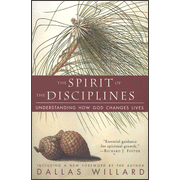
Okay, onto Willard. Dallas Willard is one of the few living authors I will willingly read. I doubt he'll put that bit of information on his resume anytime soon, but what I mean is, as I have stated in other places, is that much of what is written in contemporary times is either a) garbage or, b) recycled from previous times. Dallas takes the best of the latter and interprets and applies it with very little of the former.
This particular work of his takes some ideas that have been floating in my head for about 20 years and crystalizes them. The bottom line of the book is this--how we live as Christians matters. Not in some moralistic way, but in the very practical and spiritual way that it forms us. Just as Christ is fully God and fully man, we too are fully body and fully spirit. They two co-exist and reside within us. We can do nothing "spiritual" outside of our flesh and blood, and everything we do physically affects us spiritually.
From this obvious, though often overlooked, beginning, he lays out how discipline in the Christian life is necessary in order to train ourselves in righteousness. "Our mistake is to think that following Jesus consists in loving our enemies, going the "second mile," turning the other cheek, suffering patiently and hopefully–while living the rest of our lives just as everyone else does." (p. 5) Too often, this is the case. We go to church and talk about our "spiritual lives" as if they had nothing to do with our Monday through Saturday "real" lives.
"Either I must intend to stop sinning or not intend to stop. There is no third possibility. I must plan to follow Jesus fully or not plan to follow him." (p. 13)
Read that again.
Either I must intend to stop sinning or not intend to stop.
There is no third possibility.
I must plan to follow Jesus fully or not plan to follow him.
We cannot gloss over the way Jesus and his disciples lived their lives. They practiced regular prayer and solitude. They were disciplined in the way they lived their lives. Jesus words key us into this if we listen, "When you pray...when you fast,... when you give..." (Matthew 6) are telling. He does not say, "if," but when. The expectation is that we will do these things.
Unfortunately, through radical interpretations of reformation theology, we have largely discarded spiritual disciplines because we are afraid of "works righteousness." In truth, many of us are just lazy.
The disciplines for the spiritual life, rightly understood, are time-tested activities consciously undertaken by us as new men or women to allow our spirit ever-increasing sway over our embodied selves. They help us by assisting the ways of God's Kingdom to take the place of the habits of sin embedded in our bodies. (p. 86) They are training to be who we want to be. It takes effort on our part. Yes, God gives us the Holy Spirit and works in us and through us, but we must work with him. We cannot sit on the couch eating popcorn and expect to just poof become holier. It does not work that way, and no where in scripture does it tell us it does.
"The mark of disciplined persons is that they are able to do what needs to be done when it needs to be done." (p. 151) We understand this in the purely physical realm. I cannot expect to be able to run a half marathon on the prescribed day if I do not train myself in preparation. So why are we so flabbergasted when we cannot resist a temptation, or speak against falsehood when it comes, if we have not also trained ourselves?
Enough of my rambling. If you haven't read either of these, do yourself a favor and read them.
14 August 2011
Sermons
Well, since I've last written here, I've moved with my family to Central New York and begun an MBA at Syracuse University, courtesy of the US Army. In about a year, Lord willing, I will graduate and move on to manage resources for the Chaplain Corps....somewhere.
I've been attending, and assisting at Holy Trinity Anglican Church. So far I have delivered two sermons. They are available on the website. 14 August I spoke about Jesus Scandalous Grace and 24 July I spoke out of Romans 8 regarding suffering.
I've been attending, and assisting at Holy Trinity Anglican Church. So far I have delivered two sermons. They are available on the website. 14 August I spoke about Jesus Scandalous Grace and 24 July I spoke out of Romans 8 regarding suffering.
27 April 2011
Words Mean Things
(I know, I think I've used that title before, I promise I will probably use it again--it may even become the title of this blog eventually!)
In my studies in Anglicanism, I've been comparing the prayer books used in England and the USA throughout the history of the communion. It is certainly an interesting exercise and I think it is sharpening my theological vision.
One of the changes that has occurred that was brought to my attention by an article the late Peter Toon wrote is the addition of, "by the power of" to the Apostle's and Nicene Creeds in the 1979 US Prayer Book. You see, most renderings of the creeds say, "Who was conceived by the Holy Spirit." The 1979 changes that to read, "Who was conceived by the power of the Holy Spirit."
So, what's the big deal? Is it theological nit-picking? Well, my first question is, "Why add it?" It does nothing to clarify the text. In fact, I think it obscures it. Consider this interchange between the Pharisees and Pilate:
Consider another example. Say we're at some social function and you and I have just met. I point to a woman across the room and say, "She's my wife." If I instead said, "That woman claims to be my wife," you would most likely get a much different impression. Obviously, (and thankfully!) my wife does claim me. The second statement would not be false, but it would be misleading. It would place questions in your mind that the former statement did not. It would cast doubt on her actually being my wife.
The same is true with "This man said, "I am King of the Jews."" Those reading the sign would naturally wonder, "Does that mean he wasn't really? Is that why he's hanging there?"
"In the power of the Holy Spirit" also opens a door for us to walk through that was not present before. Obviously, if the Holy Spirit does anything, he does it through his power. I don't need to proclaim I am doing something in my own power, I only ever proclaim power when I am working on behalf of someone or something else. "By the power invested in me by the church and the state, I now pronounce you man and wife."
So, "in the power of" opens the door to another agent working, "in the power of the Holy Spirit." Like, say, Joseph? With that simple step through this theological gap created by this addition, the virgin birth is gone, and yet the appearance of orthodoxy remains because it is consistent with the revised creed. Granted, you still have that pesky line about the Virgin Mary to contend with...but I hope you see my point.
There is no historical precedent for adding "in the power of" and it creates potential problems and solves none. It only makes sense if there is an ulterior agenda at work. A revisionist, heretical agenda. It has been widely put forward in some circles that is what was at work with the 1979 prayer book. I would say this one small addition supports such a view. That is, unless someone can supply evidence to the contrary.
In my studies in Anglicanism, I've been comparing the prayer books used in England and the USA throughout the history of the communion. It is certainly an interesting exercise and I think it is sharpening my theological vision.
One of the changes that has occurred that was brought to my attention by an article the late Peter Toon wrote is the addition of, "by the power of" to the Apostle's and Nicene Creeds in the 1979 US Prayer Book. You see, most renderings of the creeds say, "Who was conceived by the Holy Spirit." The 1979 changes that to read, "Who was conceived by the power of the Holy Spirit."
So, what's the big deal? Is it theological nit-picking? Well, my first question is, "Why add it?" It does nothing to clarify the text. In fact, I think it obscures it. Consider this interchange between the Pharisees and Pilate:
Pilate also wrote an inscription and put it on the cross. It read, “Jesus of Nazareth, the King of the Jews.” Many of the Jews read this inscription, for the place where Jesus was crucified was near the city, and it was written in Aramaic, in Latin, and in Greek. So the chief priests of the Jews said to Pilate, “Do not write, ‘The King of the Jews,’ but rather, ‘This man said, I am King of the Jews.’” Pilate answered, “What I have written I have written.” (John 19:19-22 ESV)Did the Pharisees request alter the truth? No. We could argue that Jesus never actually said, "I am the King of the Jews," but his interchange with Pilate and his refusal to deny that he was make it clear enough. The Pharisee's request to change the sign hung on the cross does not change the meaning, but it changes the perception of the message.
Consider another example. Say we're at some social function and you and I have just met. I point to a woman across the room and say, "She's my wife." If I instead said, "That woman claims to be my wife," you would most likely get a much different impression. Obviously, (and thankfully!) my wife does claim me. The second statement would not be false, but it would be misleading. It would place questions in your mind that the former statement did not. It would cast doubt on her actually being my wife.
The same is true with "This man said, "I am King of the Jews."" Those reading the sign would naturally wonder, "Does that mean he wasn't really? Is that why he's hanging there?"
"In the power of the Holy Spirit" also opens a door for us to walk through that was not present before. Obviously, if the Holy Spirit does anything, he does it through his power. I don't need to proclaim I am doing something in my own power, I only ever proclaim power when I am working on behalf of someone or something else. "By the power invested in me by the church and the state, I now pronounce you man and wife."
So, "in the power of" opens the door to another agent working, "in the power of the Holy Spirit." Like, say, Joseph? With that simple step through this theological gap created by this addition, the virgin birth is gone, and yet the appearance of orthodoxy remains because it is consistent with the revised creed. Granted, you still have that pesky line about the Virgin Mary to contend with...but I hope you see my point.
There is no historical precedent for adding "in the power of" and it creates potential problems and solves none. It only makes sense if there is an ulterior agenda at work. A revisionist, heretical agenda. It has been widely put forward in some circles that is what was at work with the 1979 prayer book. I would say this one small addition supports such a view. That is, unless someone can supply evidence to the contrary.
Subscribe to:
Posts (Atom)